
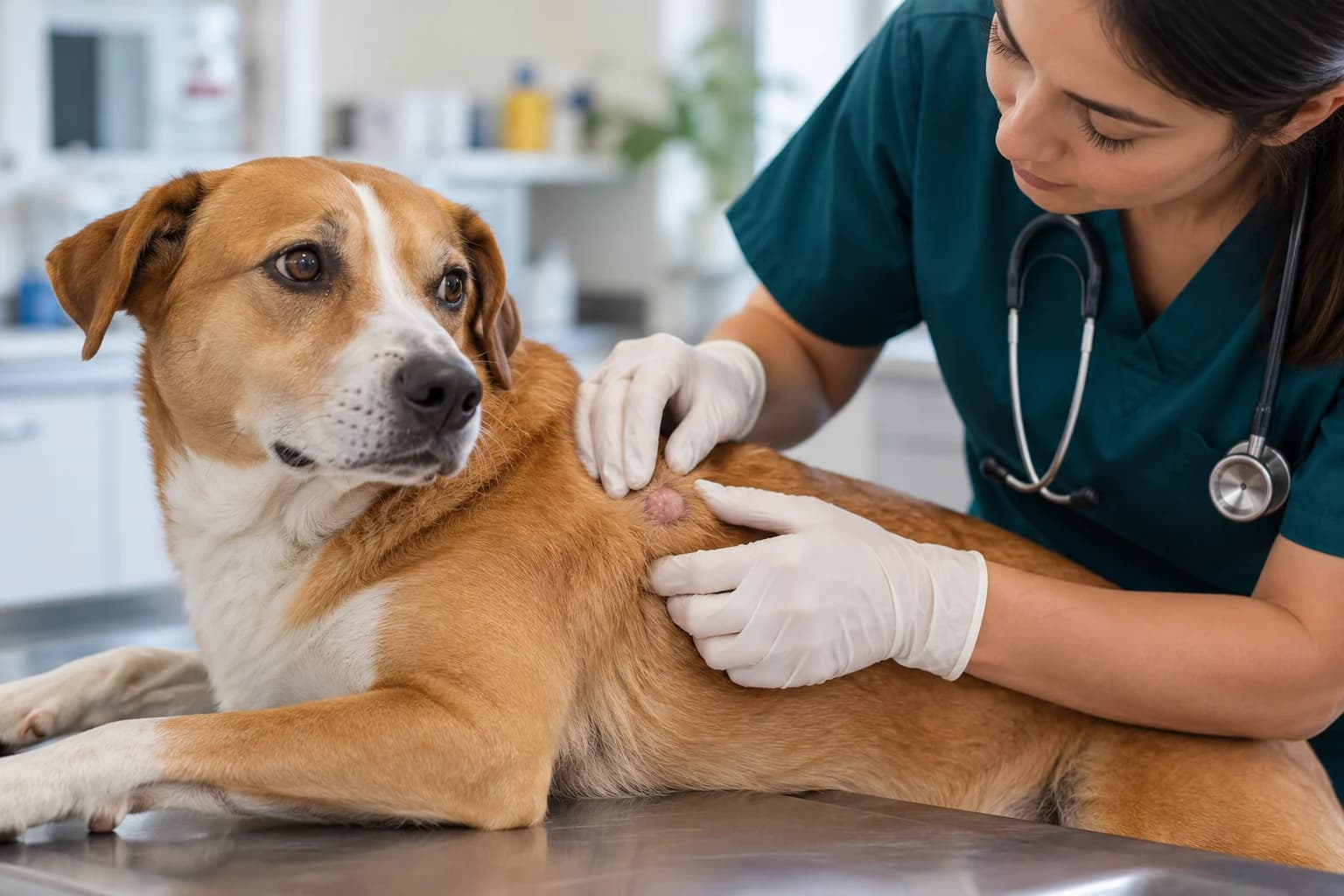
Finding a new lump on your pet can naturally raise concern, and it is completely natural to wonder whether it is something to act on or something to leave alone. The answer depends on several factors, including the lump’s size, texture, colour, whether it causes pain or discharge, and any changes in your pet’s behaviour.
This blog covers what different lumps can mean, the signs worth monitoring, when to bring your pet in, and how we assess and diagnose a growth once we do.
What Are Lumps and Growths in Pets?
Lumps and growths are abnormal tissue formations that develop under or on the surface of your pet's skin, and they range from completely harmless to medically significant. The only way to determine what a lump is is by proper veterinary evaluation.
Some growths stay small and stable for years without causing any discomfort. Others change over time in ways that point to something worth addressing sooner rather than later.
Not every lump requires immediate action, but every new lump should be noticed and monitored. If you are unsure about something you have found, a professional opinion early in the process is always the sensible approach.
What Causes Lumps and Bumps in Pets?
Lumps develop for many different reasons, and the cause is rarely obvious from the outside alone. The five most common possibilities are covered below, and understanding them helps explain why a veterinary assessment is the only reliable way to know what you are dealing with.
- Fatty lumps (lipomas) are benign fatty masses that sit just beneath the skin. They are common in middle-aged and older dogs, tend to be soft and movable, and typically grow very slowly.
- Cysts are created when a gland or follicle becomes blocked and is filled with fluid or dead cell material. If left untreated, they may burst and become infected.
- Abscesses are areas of infection that may occur after a bite, puncture wound, or when foreign material is trapped under the skin. They are usually warm, swollen, and tender spots.
- Benign growths such as warts, skin tags, and papillomas are particularly common in older animals. They rarely cause problems but can become irritated depending on their location.
- Tumours can be low-grade and benign or more serious and need to be dealt with quickly. Both can look very similar, which is why it is important to have a professional evaluation.
What Warning Signs Should You Look For?
A lump that does not change over time can be less worrisome than one that changes quickly, but appearance and behaviour alone aren't enough to determine what the lump is. However, there are some signs that growth requires a more in-depth professional analysis, and it is important to know what to look for to take the right action at the right time.
- Rapid growth over days or weeks rather than months is one of the clearest signals that a lump needs a closer look, not months of waiting to see what happens.
- A shift in texture or firmness, such as a mass that was once soft now feeling hard, or a surface that has gone from smooth to uneven, is worth flagging at your next visit.
- Colour changes on or around the lump, including darkening, reddening, or patchy pigmentation on the overlying skin, are changes we want to know about.
- Pain or sensitivity in the area, shown by your pet flinching, pulling away, or vocalising when it is touched, suggests the lump may be doing more than sitting quietly.
- Bleeding or discharge from or near the growth should always be assessed promptly, as it can point to ulceration or an infection developing beneath the surface.
- Hair loss on or around the growth, especially when your pet has not been visibly scratching or licking the spot, is something we look for during examination.
- Persistent licking or chewing at one particular area is often how owners first discover a lump they had not noticed before, and it is always worth investigating.
- Difficulty eating, moving, or swallowing may indicate that a growth is affecting more than just the skin, particularly when it sits near a joint, the throat, or the face.
When Should You Take Your Pet to the Vet?
Any new lump should be mentioned at your pet’s next veterinary checkup, but some changes need attention sooner. Being aware of which signs can wait and which require immediate attention can help you make the right decision without unnecessary concern.
Book a routine appointment if:
- A new lump has appeared that you have not looked at before.
- A growth you have been aware of has been slowly but consistently getting larger.
- Several new lumps have appeared in a short timeframe.
Seek an earlier appointment if:
- The lump has grown noticeably within the past one to two weeks.
- There is any bleeding, discharge, or visible ulceration around the area.
- Your pet seems uncomfortable, is guarding the spot, or is showing other signs that something is not right.
- The mass sits close to the face, throat, or a joint and appears to be getting in the way of how your pet eats, moves, or functions day to day.
How Does a Vet Diagnose a Lump or Growth?
Diagnosing a lump starts with understanding what it looks and feels like. We consider its size, location, texture, and other changes before deciding whether your pet needs further tests or treatment.
- The first step is always a physical examination. The size, texture, mobility, and changes in the skin and surrounding tissue of the lump are assessed.
- Fine needle aspiration (FNA) is a simple, rapid, and minimally invasive technique that uses a thin needle to aspirate a small amount of cells from the mass. This sample is then looked at under a microscope and gives some early indication of the growth.
- Biopsy is the removal of a piece of the lump or sometimes the whole mass for further laboratory examination. This procedure is used when the results of the FNA are equivocal or when a detailed tissue evaluation is required.
- Imaging such as X-rays or ultrasound is used when a lump is deeper in the body, when its full extent is unclear, or when we need to assess whether surrounding structures are involved.
Why Is Early Evaluation Important?
Early evaluation gives us a clearer idea of what the lump is and what your pet may need next. It helps us decide whether the growth can simply be monitored, needs further testing, or requires treatment.
If the lump is benign, an early check can reassure you. If treatment is needed, including pet surgery in Dubai where appropriate, timely evaluation allows us to plan the next step with the right information.
Knowing what you are dealing with is always better than watching a lump change without understanding what it is.
Why Choose The Ark Animal Clinic for Lump and Growth Evaluation?
We have been providing veterinary care for pets across the UAE and Egypt since 2013, and lump and growth evaluation is a regular part of the diagnostic work we carry out for dogs and cats of all ages and breeds.
Our veterinary teams work with in-house diagnostic tools, including physical assessment, fine needle aspiration, and imaging support. When a growth requires surgical removal, our surgical capability means that pet surgery in Dubai can be managed within our clinic for most cases, without the need for an external referral.
We explain our findings, their meaning, and your options in clear, straightforward language. Our goal is to provide you accurate information so you can make informed decisions for your pet's care.
Across our Dubai Silicon Oasis and Arjan clinics, as well as our branches in Cairo and Dahab, The Ark Animal Clinic is here to support your pet with the experience and consistency built over more than a decade of veterinary care. At The Ark, your pet is always family.

